

If you wear dentures, you’ve probably stood in the dental care aisle staring at a wall of adhesive products, wondering which one actually works. Creams, powders, strips, wafers, the options have multiplied in recent years, and so has the guidance around what’s safe, what’s effective, and when adhesive might not be the right answer at all.
Our Staten Island patients regularly ask us about denture adhesives. This guide covers everything you need to know: the different types of adhesive, what the FDA has said about ingredient safety, how to apply and remove adhesive correctly, and when excessive reliance on adhesive is a sign your dentures need professional attention rather than more glue.
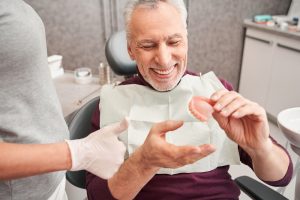
What Denture Adhesive Actually Does, and What It Can’t Fix
Denture adhesive is a non-toxic, water-soluble substance that temporarily increases the staying power of removable dentures against the gums and palate. It fills microscopic gaps between the denture base and the oral tissue, reducing movement and improving bite force.
Used correctly, adhesive can meaningfully improve confidence and comfort for patients with well-fitting dentures. Studies published in the Journal of the American Dental Association have found that denture adhesives, when used as directed, improve bite force, retention, and patient satisfaction.
But there’s an important caveat our dentists emphasize: adhesive is a supplement to a good-fitting denture, not a substitute for one. If you’re going through a full tube of adhesive every few days to keep your dentures from shifting, that’s a clinical sign your dentures need to be evaluated and likely relined or replaced. Over time, the jawbone changes shape after tooth loss, and dentures that once fit well gradually become looser. No amount of adhesive compensates for a significantly ill-fitting appliance.
The Four Types of Denture Adhesives
The denture adhesive market has expanded considerably, and today’s patients have more options than the classic cream tube their grandparents used. Here’s how the main categories compare.
- Adhesive Creams and Pastes: These are the most widely used type. Brands like Fixodent Ultra Max Hold and Super Poligrip Original (zinc-free) apply as a thin bead along the denture base and create a firm hold within minutes of contact with saliva. They’re effective for both upper and lower dentures, though lower dentures are notoriously harder to stabilize due to the tongue and less tissue surface area. Creams last most of the day for most patients.
- Adhesive Powders: Powder is sprinkled across the moistened denture surface before insertion. They create a thinner, less bulky hold than cream, which some patients prefer for feel and taste. Products like Fixodent Original Powder work well for patients with mild fit issues. Powders tend to be shorter-lasting than creams and may require reapplication after meals.
- Adhesive Wafers and Pads: Pre-cut fabric or foam pads (such as Sea-Bond Adhesive Seals) are placed on the denture surface and activated by moisture. Many patients prefer these because they’re mess-free and leave no residue on the gums. They’re particularly popular with patients who find creams difficult to apply evenly. The hold is moderate, typically not as strong as a well-applied cream, but consistent.
- Adhesive Strips: Thin, pre-formed strips offer targeted hold in specific areas of the denture. They’re less commonly used than creams or wafers but can be useful for patients who only need stabilization in one area of their appliance.
What the FDA Has Said About Zinc in Denture Adhesives
This is one of the most important updates for anyone who has been using denture adhesives for years. In 2010 and 2011, the FDA issued safety communications warning that excessive use of zinc-containing denture adhesives had been linked to zinc toxicity in some patients. High zinc levels in the body can deplete copper, which in turn can cause neurological symptoms, including numbness, tingling, balance problems, and weakness in the legs.
The patients affected were generally using far more adhesive than directed, sometimes multiple tubes per week, often because their dentures fit poorly and they were trying to compensate. Following the FDA’s alerts, most major manufacturers reformulated their products to remove zinc entirely. Super Poligrip and Fixodent now both offer zinc-free formulas as their primary products.
What this means practically: if you’re using a zinc-free formula as directed (a small amount, once daily), there is no documented safety concern. But if you find yourself using large quantities frequently, that’s a conversation to have with your dentist. Our team can evaluate your denture fit and determine whether a reline or replacement would reduce your need for adhesive significantly. You can also review our post on common denture problems to understand what a poor fit looks like and when to seek help.
How to Apply Denture Adhesive the Right Way
Improper application is one of the main reasons patients feel like the adhesive “isn’t working.” The most common mistake is using too much. More product does not equal better hold. It causes the adhesive to ooze out from under the denture, creating a messy feel in the mouth and wasting product.
For the cream adhesive, the correct technique is:
- Start with clean, dry dentures. Adhesive bonds poorly to wet surfaces and residue from the previous application.
- Apply three to four small dots (roughly pea-sized) to the denture base. For upper dentures, place them along the ridge and palate. For lower dentures, apply a thin strip along the ridge.
- Press the denture firmly into place and hold for a few seconds.
- Bite down gently and hold for 5 to 10 seconds to allow the adhesive to spread and set.
- Avoid eating or drinking for a few minutes after insertion to let the bond stabilize.
For powders, lightly sprinkle on the moistened surface and tap off any excess before inserting. For wafers or pads, simply peel, place on the clean denture, and insert as normal. The key in all cases is starting with a clean surface and using less than you think you need.
How to Remove Denture Adhesive Completely
Incomplete removal of adhesive is a common issue that leads to buildup, gum irritation, and poor adhesion the following day. Old adhesive residue on the denture surface prevents fresh adhesive from bonding properly.
- From the dentures: After removing your dentures, rinse them under warm (not hot) water. Use a soft-bristle denture brush, not a regular toothbrush, to scrub away all adhesive residue. Most modern water-soluble adhesives dissolve with warm water and gentle brushing. Avoid using toothpaste, which is too abrasive and can scratch the denture surface. Some patients find that soaking dentures in warm water for a few minutes first loosens stubborn residue more easily.
- From the mouth: Rinse with warm water and use a damp, soft cloth or gauze to wipe the gums and palate gently. Repeat until all visible residue is removed. Your gums need to breathe overnight, so thorough cleaning before bed matters. Leaving residue on the gum tissue can contribute to soreness and tissue changes over time.
When Adhesive Use Is a Warning Sign
Our dentists in Staten Island want patients to know that needing adhesive is not inherently a problem. Millions of denture wearers use it safely and comfortably every day. But specific patterns suggest something more needs attention:
- You’re using more than one tube every two to three weeks.
- Your dentures still shift or click despite using adhesive.
- You’ve noticed your dentures have become increasingly loose over the past year or two.
- You have sore spots on your gums that don’t resolve.
- You’re avoiding certain foods because you don’t trust your dentures to stay put.
Any of these patterns is worth a conversation with our team. Denture relining, resurfacing the base of the denture to match your current ridge shape, is a straightforward procedure that can dramatically restore fit without replacing the entire appliance. In some cases, new dentures are the better investment.
Modern Alternatives Worth Knowing About
Denture adhesive has been the standard solution for fit issues for decades, but it isn’t the only option available to Staten Island patients today.
- Denture Relining: A reline reshapes the denture’s tissue-contact surface to better match the current shape of your gums and jawbone. It can be done chairside in a single appointment for a temporary reline, or sent to a lab for a more durable permanent reline. This is the most practical first step when dentures have gradually become looser, and adhesive use has increased.
- Implant-Supported Dentures: For patients who want a more permanent solution, dental implants placed in the jawbone can anchor a denture securely without any adhesive. Implant-supported dentures (also called overdentures) snap onto implants and can be removed for cleaning, but they don’t move during eating or speaking. Many of our patients who make this transition describe it as life-changing. Our detailed guide on transitioning from dentures to dental implants walks through the process, costs, and candidacy factors in depth.
If you’re curious whether implants or a reline might be right for you, contact our Staten Island office to schedule an evaluation. Our team sees denture patients from Tottenville, Great Kills, Annadale, Arden Heights, and across the South Shore, and we’re happy to walk you through every option.
Frequently Asked Questions About Denture Adhesives
Is it safe to use denture adhesive every day?
Yes, when used as directed, daily use of a zinc-free denture adhesive is considered safe. The key is using the recommended amount, a few small dots or a thin strip, rather than large quantities. If you’re using excessive amounts daily to maintain fit, schedule a denture evaluation to address the underlying fit issue.
Can I use denture adhesive with partial dentures?
Denture adhesive is designed primarily for complete (full) dentures. Partial dentures rely on clasps and remaining natural teeth for retention and generally don’t benefit from adhesive in the same way. If your partial feels loose, the clasps may need adjustment. Have a dentist evaluate the fit rather than reaching for adhesive.
When should I see a dentist instead of using more adhesive?
If your dentures are visibly loose, if you’re going through a full tube every week or less, if you have persistent sore spots on your gums, or if your dentures are more than five to seven years old, it’s time for a professional evaluation. Excessive adhesive use is often a sign that bone resorption has changed the shape of your ridges.
Keep Your Restorations in Great Shape
Whether you need help choosing the right adhesive, want your current dentures evaluated for fit, or are curious about implant options, our team is here to help. Call (718) 948-5111 or book your appointment online. We see patients from across Staten Island, from the South Shore communities of Tottenville and Great Kills to Annadale, Arden Heights, and beyond.