You’ve canceled the appointment again. Maybe you told yourself you’d reschedule next week, and next week came and went. For tens of millions of Americans, avoiding the dentist isn’t laziness. It’s fear. Real, physical, hard-to-explain fear that makes something as routine as a cleaning feel impossible.
According to the American Dental Association, dental anxiety affects a significant portion of the adult population, and a meaningful percentage of patients avoid the dentist entirely because of it. At Nasso, Olsen & Napolitano in Staten Island, our team has worked with hundreds of patients who came to us after years of avoidance. Many of them are now on regular six-month schedules. The difference? Sedation dentistry.
This guide covers everything you need to know about sedation dentistry: what it is, how each option works, who qualifies, what to expect, and why so many of our patients say it was the decision that finally gave them their oral health back. Leave your fear behind and contact our Staten Island dentists today at (718) 948-5111.
The Real Cost of Avoiding the Dentist (It’s Not Just Cavities)
Dental anxiety doesn’t just affect how you feel in the waiting room. It affects your teeth, your gums, your confidence, and your wallet.
Here’s what typically happens when fear keeps patients away from regular care: a small cavity that could have been caught at a routine cleaning in 2022 becomes a tooth that needs a root canal by 2026. A little early-stage gum disease that responds well to a professional cleaning and some home care becomes advanced periodontal disease requiring surgery. A cracked tooth that was easily repaired six months ago becomes an extraction today.
A dental filling might cost $150 to $300. A root canal costs $1,000 to $2,500. A dental implant to replace a lost tooth? Up to $3,000 to $5,000 per tooth. Anxiety-driven avoidance is one of the most expensive dental decisions a patient can make.
Patients who avoid the dentist often know their teeth aren’t in great shape. That knowledge feeds more anxiety about what the dentist will find, which makes it even harder to pick up the phone. We see this pattern constantly at our Staten Island practice, and we want you to know that our team doesn’t judge. We’ve helped patients who haven’t been to a dentist in 15 years feel comfortable and cared for on their first visit back.
If anxiety is the root of the problem, our guide on overcoming dental anxiety has useful strategies to start with. But if you’ve tried willpower and it hasn’t worked, sedation dentistry offers a different solution.
What Is Sedation Dentistry?
Dental sedation uses medication to help patients relax during procedures. It’s sometimes called “sleep dentistry,” which is a bit misleading. Most sedation options don’t put you to sleep. They quiet your nervous system so that you’re calm, comfortable, and largely unaware of what’s happening in your mouth, while still being able to breathe on your own and respond if needed.
Think of it this way: the goal isn’t unconsciousness. It’s a state where your body isn’t fighting the procedure, your mind isn’t spiraling, and your dentist can work efficiently and carefully. Most sedated patients describe the experience as time collapsing. They sit down, feel the sedation take effect, and the next thing they know, the procedure is over.
This approach is typically recommended for:
- Patients with moderate to severe dental anxiety or phobia
- People whose gag reflex makes dental work extremely difficult
- Patients who have trouble getting numb from local anesthesia alone
- Anyone undergoing a lengthy, complex, or multi-step procedure
- Patients who want to complete several treatments in a single visit to save time
- Children or individuals with special needs who cannot remain still during treatment
- Patients with sensory sensitivities that make dental environments feel overwhelming
The Types of Sedation at Our Staten Island Practice
Nitrous Oxide (Laughing Gas)
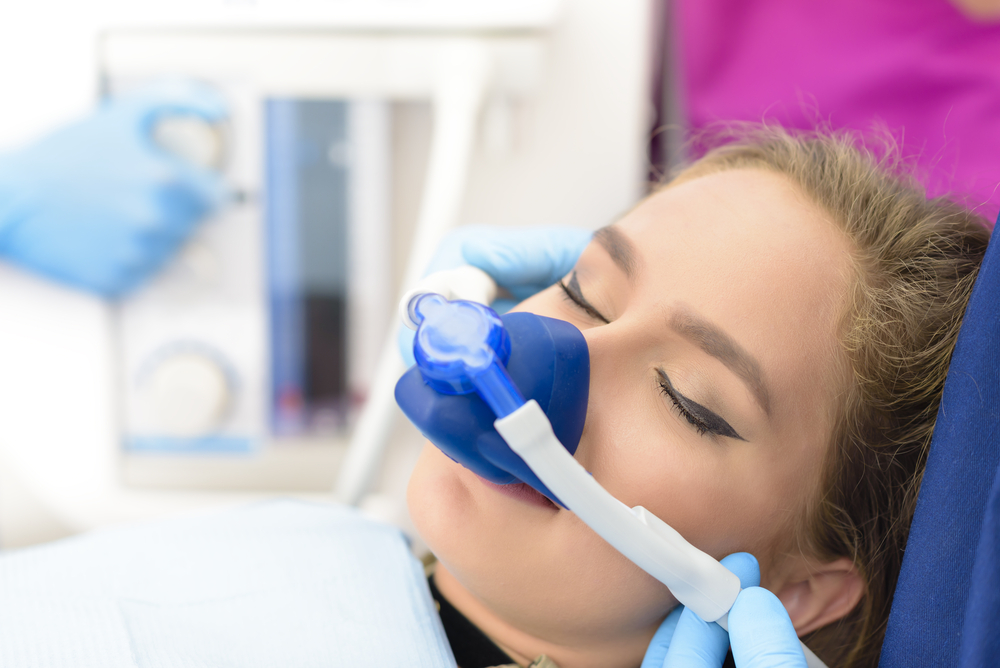
Nitrous oxide is the lightest, most commonly used form of dental sedation, and it’s been used safely in dentistry for well over a century. A small, comfortable mask is placed over your nose, and you breathe a mixture of nitrous oxide and oxygen. Within a few minutes, you’ll feel pleasantly relaxed, warm, and a little floaty. Pain perception decreases, anxiety lifts, and time feels like it moves faster. You stay fully awake and can communicate with our team the entire time. When the mask is removed, the effects clear within minutes. Most patients can drive themselves home and return to normal activities immediately. Nitrous oxide is ideal for mild to moderate anxiety and shorter procedures like cleanings, fillings, and simple extractions.
Oral Conscious Sedation
For patients who need deeper relaxation, we prescribe a sedative medication (typically from the benzodiazepine family) that you take by mouth about an hour before your appointment. By the time you arrive at our Staten Island office, you’ll already feel deeply calm and likely drowsy. Many patients doze through the procedure. Memory of the experience is often very limited. You’ll need a trusted adult to drive you to and from your appointment and stay with you at home for the day. Oral sedation is an excellent choice for moderate to severe anxiety and for procedures that take an hour or longer.
IV Conscious Sedation
IV sedation delivers medication directly into your bloodstream through a small intravenous line, typically placed in your arm or hand. This allows our team to precisely adjust your sedation level throughout the procedure in real time. It takes effect within seconds and produces a deeply relaxed state where most patients retain no memory of the treatment. You’ll need a driver, and plan on spending several hours at home recovering afterward. IV sedation is recommended for patients with severe anxiety, those undergoing complex procedures, or anyone who wants to combine multiple treatments into a single appointment.
Why Staten Island Patients Say Sedation Dentistry Changed Everything
Here’s what actually changes for patients who choose sedation dentistry. It goes well beyond “feeling calmer.”
- More treatment happens in fewer visits. When you’re relaxed and comfortable, your dentist can work without interruption. Procedures that might normally span three or four appointments can often be completed in one or two visits. For patients with busy lives or significant dental needs, this is a meaningful difference.
- The fear response quiets down. Dental anxiety is a learned response. Every difficult dental experience reinforces it. Sedation breaks that cycle. When your brain stops associating the dentist’s chair with fear and pain, future appointments become less daunting. Many of our patients who started with oral sedation now come in for routine cleanings with just nitrous oxide or nothing at all.
- Gag reflexes stop interfering. A sensitive gag reflex is one of the most common reasons patients struggle through dental work. It makes X-rays uncomfortable, impressions miserable, and posterior procedures nearly impossible. Sedation relaxes the muscles involved and reduces that reflex significantly, making the experience far more manageable for both patient and dentist.
- Memory is limited. Patients using oral or IV sedation typically remember very little of the procedure. For those whose dental history includes traumatic experiences, this is not a small thing. They receive the care they need without adding to the mental library of difficult dental memories.
- Oral health actually improves. This might sound obvious, but it bears saying: sedation dentistry helps people get the dental care they’ve been avoiding. Patients who hadn’t seen a dentist in years can finally address long-standing issues. They address root canal therapy they’d delayed, complete restorative work they’d been dreading, and establish the routine care habits that keep everything stable going forward.
Is Sedation Dentistry Safe?
Safety is the first question most patients ask, and it’s the right one. The short answer is yes — sedation dentistry is safe when administered by trained, credentialed dental professionals who follow proper protocols.
Before recommending any sedation option, our team at Nasso, Olsen & Napolitano conducts a thorough review of your medical history, current medications, supplements, and any known health conditions. Certain factors can affect how sedatives interact with your system, and we take this screening seriously. Nothing is rushed.
According to research published by the National Institutes of Health, serious complications from dental sedation administered by qualified providers are rare. The most common side effects, mild nausea, temporary grogginess, or lingering drowsiness, typically resolve within a few hours.
To keep every sedation appointment as safe as possible, we ask patients to:
- Disclose all medications and supplements, including herbal products, before the appointment
- Follow any fasting instructions provided (required for IV sedation and general anesthesia)
- Arrange a responsible adult driver for oral and IV sedation procedures
- Avoid alcohol for at least 12 hours before the appointment
- Wear loose, comfortable clothing to the appointment
We monitor your vital signs throughout every sedation procedure and keep emergency equipment and reversal agents on hand. Every safety protocol is explained to you and your accompanying adult before treatment begins. There are no surprises.
Who Makes a Good Candidate for Sedation Dentistry?
This option isn’t reserved for patients with severe, diagnosable phobias. You may be a strong candidate if any of the following apply:
- You feel significant anxiety before or during dental appointments, even routine ones
- You’ve delayed or canceled dental care for more than a year due to fear
- You have a strong gag reflex that makes dental work uncomfortable or difficult
- You’ve had trouble getting adequately numb with standard local anesthesia
- You need extensive dental work and want to minimize the number of appointments
- You have sensory sensitivities that make the sounds, smells, or physical sensations of dental care difficult to tolerate
- You’re scheduling a procedure like a complex extraction, root canal therapy, or oral surgery that you’d rather not be fully alert for
- You’re considering children’s dentistry for an anxious child or a child who needs extensive treatment
Not every patient qualifies for every type of sedation. Certain respiratory conditions, sleep disorders, or medication interactions may limit your options. Pregnancy is another factor we evaluate carefully. That’s why a pre-sedation consultation with our Staten Island dental team is always the first step — it’s the conversation where we find the right fit for you specifically.
Frequently Asked Questions About Sedation Dentistry in Staten Island
Will I be unconscious during sedation dentistry?
Only with general anesthesia. Nitrous oxide, oral conscious sedation, and IV sedation all keep you in a conscious but deeply relaxed state. You can respond to your dentist’s instructions and communicate if needed. The experience feels profoundly calm rather than “out cold.” Most patients using oral or IV sedation remember little to nothing of the procedure afterward, but they were never fully unconscious during it.
How long does it take to recover from dental sedation?
It depends on the type. Nitrous oxide clears your system within 5 to 15 minutes of removing the mask. Most patients drive themselves home and feel completely normal shortly after. Oral conscious sedation leaves patients drowsy for several hours, so plan to spend the rest of the day resting. IV sedation recovery varies but typically takes 2 to 4 hours before patients feel alert. We give you detailed recovery instructions at your appointment so you know exactly what to expect.
You Can Feel Comfortable at The Dentist’s Office
If you’ve been putting off dental care because of fear, the team at Nasso, Olsen & Napolitano is ready to help. We serve patients throughout Staten Island, including Tottenville, Great Kills, New Dorp, and surrounding neighborhoods. Call us today at (718) 948-5111 to schedule a sedation dentistry consultation. You’ve waited long enough; let’s take care of your smile.