

Most people know they should see the dentist twice a year. Far fewer actually do it. Life gets busy, appointments get pushed, and as long as nothing hurts, it’s easy to convince yourself that everything is probably fine.
The problem with that logic is that most serious dental problems don’t hurt until they’re already expensive. A cavity that could have been filled for $150 at a routine visit becomes a root canal at $1,500 after 18 months of avoidance. Early-stage gum disease that’s reversible with a professional cleaning becomes a chronic condition requiring surgery once it progresses. What your dentist can catch and fix in 20 minutes today might take a full afternoon and a much larger check in two years.
According to the American Dental Association, cost and lack of perceived need are two of the most common reasons adults skip dental care, yet routine preventive visits are precisely what keep costs manageable and perceived needs from becoming real ones.
At Nasso, Olsen & Napolitano, we’ve been providing dental care to Staten Island families for years. This guide covers what actually happens at a regular dental visit, why skipping has real consequences, and how to find the right dentist near you for the long haul. To schedule a new patient appointment with Staten Island dentists, call our office at (718) 948-5111.
You Don’t Have to Wait Until Something Hurts
Pain is a terrible early-warning system for dental problems. Tooth decay can quietly destroy 50% or more of a tooth’s structure before it produces any discomfort. Gum disease progresses silently for years. Oral cancer, one of the most survivable cancers when caught early, rarely causes pain in its earliest stages, when treatment is most effective.
This is the core reason routine dental visits exist. Not to fix problems that are already bothering you, but to find problems before they bother you at all.
At a typical twice-yearly checkup, your dentist and hygienist are doing several things at once:
- Checking for signs of tooth decay, including in areas you can’t see or feel
- Examining your gums for early signs of periodontal disease
- Screening for oral cancer by examining soft tissue in your mouth, throat, and jaw
- Reviewing your X-rays for bone loss, impacted teeth, or abnormalities below the gumline
- Removing tartar buildup that your toothbrush simply cannot reach, no matter how well you brush
- Identifying bite issues, grinding patterns, or jaw problems before they cause damage
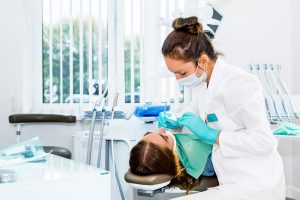
What Actually Happens During a Regular Dental Checkup
A lot of patients aren’t sure what a routine visit actually involves, especially if it’s been a while. Here’s a clear breakdown of what you can expect when you come in for a standard checkup and cleaning at our Staten Island practice.
- The health history review. If it’s your first visit, or if significant time has passed since your last one, we’ll review your medical history. Certain medications, health conditions, and lifestyle factors affect your oral health in ways that matter for your treatment. This is also when you tell us about anything that’s been bothering you, even if you think it’s minor.
- Dental X-rays. Modern digital X-rays expose patients to minimal radiation, far less than a cross-country flight. They let our dentist see between teeth, below the gumline, and inside the jawbone: areas where problems often begin but can’t be spotted with the naked eye. X-rays are typically taken once a year, or more frequently if something warrants monitoring.
- The clinical exam. We’ll examine each tooth individually, check your bite, and evaluate the health of your gums and soft tissue. This is when they’ll note any areas of concern, measure gum pocket depths, and screen for oral cancer. The exam typically takes 10 to 15 minutes and is painless.
- The professional cleaning. Your dental hygienist removes plaque and tartar (hardened plaque that brushing can’t remove), cleans between your teeth, and polishes the surfaces. Even patients with excellent home hygiene habits benefit from professional cleaning; tartar accumulates in spots that are nearly impossible to fully clean with a toothbrush and floss alone.
- The conversation. Good dental visits include a real conversation. Our team should explain anything they found, answer your questions without rushing, and give you personalized guidance on what to watch for and how to improve your home care if needed. If you’re uncertain about something or nervous about a recommendation, speak up. A great dentist wants you to leave feeling informed, not anxious.
The Hidden Cost of Skipping Your Dental Checkup
Skipping a dental visit once rarely causes an immediate crisis. Skipping year after year almost always does. Here’s what tends to happen when preventive care falls away:
- Cavities compound. A small cavity caught at a routine visit becomes a dental filling. Left unaddressed, it reaches the nerve and becomes a root canal. Left even longer, it can destroy enough structure that the tooth can’t be saved and requires extraction. The cost, discomfort, and treatment complexity increase at every stage.
- Gum disease advances silently. Gingivitis, the earliest stage of gum disease, is completely reversible with a professional cleaning and improved home care. But without treatment, it progresses to periodontitis, which causes permanent bone loss around your teeth. At that point, management becomes ongoing rather than curative, and you face a lifetime of more intensive dental care.
- Small problems become structural ones. A hairline crack in a tooth that your dentist would have spotted at a routine visit becomes a broken cusp under chewing pressure. A slightly worn-down bite from nighttime grinding gradually shifts your jaw alignment. A loose old filling lets bacteria in and causes decay underneath. Each of these has a simple, affordable solution early on. Each becomes significantly more complex over time.
- Early cancers get missed. The five-year survival rate for oral cancer is roughly 84% when caught at a localized stage, according to the Centers for Disease Control and Prevention. That rate drops significantly once it spreads. Oral cancer screenings happen at every routine dental visit — making a checkup one of the simplest things you can do for your overall health.
What Makes a Great Dentist
Finding a dentist is easy. Finding the right dentist, one you’ll actually want to keep seeing year after year, takes a little more thought. Here’s what genuinely matters:
- Experience and credentials. How long has the dentist been practicing? Do they pursue continuing education to stay current on techniques and technology? Our dental team in Staten Island brings decades of combined experience across general, cosmetic, and restorative dentistry, and we regularly invest in updated training and equipment.
- Range of services. Ideally, your primary dental practice handles most of your needs without constant referrals. A general dentist who also offers cosmetic treatments, restorative options, and children’s dentistry means your whole family can see the same trusted team in the same familiar office.
- How they handle anxiety. Dental anxiety is real and extremely common. A dentist who acknowledges that, gives you control over the pace of your appointment, and offers sedation dentistry options for patients who need them is a much better long-term partner than one who rushes through every visit. If you struggle with anxiety, ask about this directly before committing to a practice.
- Communication style. Does the dentist explain what they’re doing and why? Do they give you honest recommendations without pressure? Do staff members treat you like a person, not a chart number? These things matter more than you might expect; they’re the difference between a dental relationship that lasts decades and one that falls apart after a year.
- Availability and location. A dentist who’s 45 minutes away or whose schedule never fits yours is a dentist whose appointments you’ll quietly stop making. Proximity and scheduling flexibility are practical necessities, not extras. That’s why so many patients search for a “dentist near me” — because convenience is part of consistency.
Why Choosing a Dentist in Staten Island Makes a Difference
There’s a meaningful difference between seeing a dentist who knows your name and one who’s seeing you for the first time every time you walk through the door. Long-term dental relationships allow your provider to track changes over time — a tooth that’s been slightly sensitive for two years, a gum pocket that’s been slowly deepening, a bite that’s shifted since your last set of X-rays. These longitudinal observations catch things that a brand-new provider, starting from scratch, simply can’t see.
At Nasso, Olsen & Napolitano, we serve patients from across Staten Island, including Tottenville, Great Kills, New Dorp, Eltingville, and surrounding communities. Many of our patients have been with us for 10, 15, or even 20 years. We know their medical histories, their anxiety triggers, and their kids’ names. When you build that kind of relationship with a dental practice near you, keeping up with regular visits becomes far less of a chore — and far more of a habit you actually maintain.
Frequently Asked Questions About Regular Dental Visits
What if I haven’t been to the dentist in several years?
Come in. Seriously, no matter how long it’s been, our team will meet you where you are without judgment. Patients who haven’t seen a dentist in five or ten years often worry about what they’ll find, but the longer you wait, the more complex things become. Your first visit after a long gap will be more comprehensive than a routine checkup, but it’s also the most important appointment you can make. We’ll create a clear plan together and prioritize what needs to be addressed first.
Are dental X-rays safe?
Yes. Modern digital X-rays expose patients to a very small amount of radiation — significantly less than what you’re exposed to during a typical day just from background environmental sources. The diagnostic benefit of X-rays far outweighs the negligible risk. They allow your dentist to detect decay between teeth, bone loss, infections, and structural issues that simply cannot be seen during a visual exam. We use lead aprons as a standard precaution and take X-rays only as frequently as clinically necessary.
What if I’m nervous about going to the dentist?
Tell us. Dental anxiety is one of the most common reasons patients avoid care, and it’s something we take seriously at our Staten Island practice. We adjust our pace, explain everything before we do it, and offer sedation dentistry options ranging from nitrous oxide to oral conscious sedation for patients who need more support. You don’t have to white-knuckle your way through a dental visit to get the care you need. Call us at (718) 948-5111 and let’s talk through your options before you even schedule.